Man and Church
Venerable Serapion: The Heights of Humility

Today, Orthodox Christians on the New Calendar celebrate the feast day of Venerable Serapion the Wonderworker.
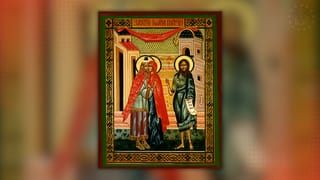
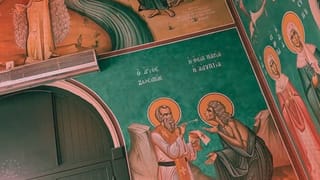
According to the experience of the saints, there are heights that can be reached only by descending. The phrase “the heights of humility” comes from the Troparion of St. John Chrysostom, but it applies with particular force to another saint whose humility was expressed in a strikingly literal way: Venerable Serapion the Wonderworker, Abbot of the Monastery of St. John the Baptist in the Davit-Gareji Wilderness.
St. Serapion was known both for his ascetic life and for the miracles granted through him. When bandits stole sacred vessels belonging to the monastery, he pursued them alone, carrying his staff. The robbers, seeing a terrible flame proceeding from it, abandoned their plunder and fled. On another occasion, he perceived from his cell that servants traveling toward the monastery had been attacked. He immediately prayed, and the animals carrying the monastery's goods later arrived safely, still bearing their burdens, the thieves having abandoned them.
Yet the most revealing act of his life may have come near its end.
Having relinquished his leadership of the monastery and entered into greater seclusion, Serapion was told by God that his death was near. He prepared his own grave — not in a place of honor, not within the church, nor even in some quiet corner of the monastery — but beneath the church gates. He asked the brethren to bury him there so that all who entered the church grounds would walk over his grave.
The Church has often placed the relics and tombs of saints in places of honor. We venerate them, ask their prayers, and remember that the bodies of those who have become temples of the Holy Spirit are not ordinary remains. Serapion's choice therefore seems almost deliberately contrary to the instincts of human honor. He did not seek to be placed where people would bow before him. He asked to be placed where they would pass above him.
This was clearly not self-love; but it was clearly also not self-hatred. Neither was it a theatrical display of abasement. It was a final confession of what he had sought throughout his monastic life: to achieve humility before God and his fellow man.
In reading about St. Serapion, I could not help but think of another man over whom many others had walked, a near contemporary of Serapion: Uriel da Costa. Da Costa’s life was marked both by religious coercion and religious freedom (heterodoxy always makes for strange bedfellows). His family had been forced to convert to Catholicism from Judaism, and he himself later struggled through both religions, increasingly questioning religious authority and tradition. He eventually became convinced that he could see through the claims of religion and rely entirely on his own reason. His relationship with Judaism was unstable, and his conflicts with the Jewish community led to repeated excommunication.
The famous punishment inflicted upon him in 1640 was cruel. As part of a public penance, for the crime of encouraging Christians not to convert to Judaism, he was lashed and made to lie at the threshold of the synagogue while members of the congregation stepped over his body as they left. By all accounts, he was physically trampled and stomped on, perhaps even spat on, not merely passed over.
In his resulting bitterness, Da Costa increasingly chose to make himself the judge of religion. He rejected the immortality of the soul and outwardly conformed to Jewish practices in which he had little conviction. The pain and humiliation he suffered filled him with a desire for revenge, and it compelled him to increasing unbelief.
Just prior to the lashing and trampling he received, he described himself as having become an “ape amongst the apes” by trying to rejoin his religious community. Rationalism had not elevated him. It had reduced him, and the whole of man as a consequence, to something mortal and animal, deprived of the eternal destiny for which he was made. His thought would later help prepare the intellectual ground for Spinoza's own austere rationalism, with its impersonal and mortal understanding of human existence.
There is a profound difference between chosen humility and imposed humiliation. Da Costa chose pride and received humiliation, and his humiliation fed his pride. Serapion chose humility and received exaltation, and his exaltation compelled him to seek an even deeper humility. Both men were walked over and upon. But nothing could make their paths more different. One went up by his own power and fell down; the other went down of his own free will and came up by means of a power on high.
Hamlet is beset by enemies who think they are outsmarting him, but he sees what they are up to and so speaks of his enemies' efforts to work secretly beneath him: “But I will delve one yard below their mines / And blow them at the moon.” Rosencrantz and Guildenstern believed they were working beneath the surface, under-"mining" Hamlet while pretending friendship. Hamlet's answer is to go deeper still. He will descend beneath those who seek to undermine him and thereby overcome them.
The demons and the passions also work beneath us. They undermine us, drawing us downward through pride, resentment, self-justification, anger, fear, and despair. Their purpose is to bring man low in the destructive sense — to reduce him, enslave him, and finally separate him from God. St. Serapion’s and da Costa’s distinct examples seem to point to the same conclusion: the answer to the passions is not to assert ourselves. The answer to the passions is to go lower.
A grave is already low. It is, in a sense, a mine dug into the earth. But Serapion chose a grave lower still: beneath the feet of all who entered. He went below even the place where men ordinarily go in death. And in that descent he found the strange elevation of humility. He went lower in order to reach the heights.
St. Dorotheos of Gaza described this movement with one of his most memorable analogies:
Suppose a man for some reason dives into the sea: if he knows the art of swimming, what does he do when a great wave comes along? He ducks under until it goes past and then he goes on swimming unharmed. But if he is determined to set himself against it, it pushes him away and hurls him back a great distance, and when again he begins to swim forward another wave comes upon him, and if again he tries to swim against it, again it forces him back, and he only tires himself out and makes no headway. But if he ducks his head and lowers himself under the wave, as I said, no harm comes to him and he continues to swim as long as he likes.
This is the path St. Serapion chose. The wave comes, and the proud man insists upon standing against it. He must prove himself, vindicate himself, preserve his dignity on his own terms. He fights and is thrown backward. Another wave comes, and he fights again. But the humble man ducks beneath it.
St. Dorotheos's image offers a better path than the one da Costa followed. Da Costa fought the waves of the world, of religious conflict, of humiliation, and of suffering, and was ultimately pushed back into unbelief and the reduction of man to mere animalism. His suffering was genuine, and the cruelty done to him should not be minimized. Yet suffering can become an occasion either for humility or for pride. He chose increasingly to trust the judgment of his own reason above every inherited claim to truth. St. Serapion chose the opposite direction: he went under, both figuratively and literally.
And yet he was not forgotten beneath the ground. The one who chose to go low was raised up in the memory of the Church as Venerable Serapion the Wonderworker.
This is the paradox of the heights of humility. The world sees elevation as the ability to stand above others. The saints show another kind of ascent. They descend beneath pride, beneath self-importance, beneath the need to win every argument and preserve every appearance of dignity. In doing so, they do not become less human. They become more fully what man was created to be.
The grave beneath the monastery gates was therefore not the last word about Venerable Serapion. It was a sign of the road by which he had already traveled. He went down freely, and God raised him up. He chose the low place, and the Church now honors him among the saints.
Venerable Serapion, by thine example thou didst teach us to be low. Pray to God for us, that we may acquire that humility which keeps us swimming forward, beneath the passions of this world, until, by the grace of God, we are blown at last to paradise.
Read also