Man and Church
The Parents’ Phariseeism Drives Children from the Church
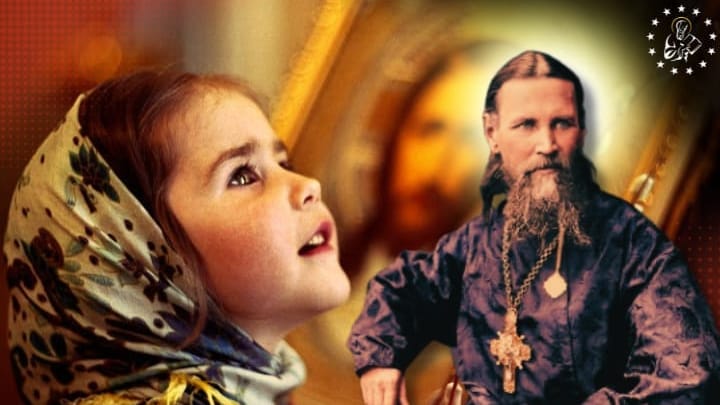
There is a kind of family misfortune that people in church circles don’t like to talk about.
From the outside, everything looks perfect: fasts are observed, the prayer rule is fulfilled, the child confesses and receives Communion on schedule. But inside the child there is emptiness and alienation. The teenager attends Sunday services as if it were a chore, shuts themselves in their room at home, and for no apparent reason, a chasm opens up between them and their parents.
The first thing ordinary parents do is look for the cause outside themselves: the smartphone, bad friends, school, harmful influences. Often, it never occurs to them that they, themselves, might be at fault.
When you want to talk about such problems, you want to speak with someone who won’t indulge you, but who is used to speaking plainly. That person is St. John of Kronstadt.
For nearly a quarter of a century, St. John taught the Law of God [religious education/catechism] at the Kronstadt gymnasium and saw an entire generation up close. Outwardly, they were all Orthodox, with mandatory services and certificates of confession. Inwardly, however, they were already leaning toward nihilism and godlessness. He saw the roots of this fracture and understood its nature. He also kept a diary in which he wrote with great honesty about his own irritability and lack of love.
So, what does St. John have to say about this painful matter?
“There is some kind of hypocritical deception in schooling,” the pastor replies, “when the Law of God is merely one of the subjects in the curriculum. There is a teacher of the Law, there is a program, there is a grade, a measure of knowledge, and that’s it. The results of such an approach to teaching are truly terrible.”
Though spoken about the gymnasium and its teachers, his words strike directly at our everyday church life. We have turned faith into a school subject with a grading system. You prayed, stood through the service, didn’t eat meat—pass. You resisted, wore the wrong clothes to church—fail. The child quickly learns the rules of the game and masters how to get an excellent grade in this subject without investing even an ounce of their heart. We rejoice at our child’s grades and fail to notice that we have given them a dried flower instead of a living one: the petals are in place, the shape is perfectly preserved, but it doesn’t smell and doesn’t grow.
But we’re doing all this for the salvation of our child! We care about their soul, isn’t that love? “Malice sometimes enters the heart under the guise of zeal for the glory of God or the good of our neighbors,” he writes in his diary. “Do not trust your zeal in such cases: it is false or foolish zeal.”
This is where it becomes uncomfortable. We think we are raising our voice at the teenager out of love for God. In reality, this is our own wounded pride speaking: “He dared to disobey us! He made us look like bad Christians!” And so we punish the child, hiding behind piety. The words we speak may be perfectly correct. The problem is that, without love, even the most correct phrase reaches the child as a cold sound. They don’t hear the meaning, only the irritation, and they pull away.
Eventually, they leave the Church. Once they’re out in the secular world, the teenager is accepted without any conditions. At home, love is made conditional on following the rules. It turns out that the secular world gives the child warmth, while the believing family meets them with coldness and fault-finding.
The child chooses warmth and acceptance. And who can blame them? They are not running from Christ, whom they cannot see behind our constant lectures. They are running from the coldness of domestic Pharisaism, mistakenly taking it for the true face of faith.
So what should we do? Here, too, St. John is clear. “In education it is extremely harmful to develop only the intellect and reason while leaving the heart unattended,” he writes. “The greatest attention must be paid to the heart.” And he adds: “Above all, learn the language of love, the most living, the most expressive, the most powerful language.”
It turns out we must begin not with the child, but with ourselves. We must acknowledge our own spiritual bankruptcy, stop preaching, and fall silent. And perhaps, for the first time in many years, we should ask the teenager for forgiveness: for having blocked God from their view, for having replaced His living face with our own irritated one.
Mind you, this is not a pedagogical technique that guarantees results. There is no guarantee that the child will return to the Church after our words. But it is often from this feeling of parental helplessness that real positive change begins.
“The life of the heart is love,” says the righteous John of Kronstadt, “and its death is malice and enmity. The Lord keeps us on earth precisely so that love may completely penetrate our heart: this is the purpose of our existence.”
The task of raising children is not to correct their behavior or persistently train them to attend services, but to ensure that our love finally reaches the place where coldness has long settled. Only from this does the road back to God begin, both for us and for our children.
This article was first published by the UOJ’s Ukraine bureau.